

Party Wall Agreed Surveyor: The Complete Guide to Streamlining Your Property Project
When planning construction work that affects a shared wall with your neighbour, you’ll quickly encounter the Party Wall Act 1996—and with it, the crucial decision of who will oversee the process. Enter the Party Wall Agreed Surveyor, a professional who can transform what might be a contentious, expensive process into a streamlined, cost-effective solution. This single appointment, mutually accepted by both property owners, offers a smarter alternative to the traditional approach of each party hiring separate surveyors. 🏗️
Understanding the role and benefits of a Party Wall Agreed Surveyor isn’t just about saving money—it’s about ensuring your building project proceeds smoothly, legally, and with minimal conflict. Whether you’re planning a loft conversion, basement excavation, or simple wall repairs, this comprehensive guide will equip you with everything you need to know.
Key Takeaways
- A Party Wall Agreed Surveyor is a single professional appointed by mutual consent of both the building owner and adjoining owner to oversee party wall matters, eliminating the need for two separate surveyors.
- Cost savings can be substantial, often reducing surveyor fees by 50% or more compared to appointing two individual surveyors and potentially a third surveyor for dispute resolution.
- The agreed surveyor must remain completely impartial, acting in the interests of both parties equally while ensuring compliance with the Party Wall Act 1996.
- Appointment requires written consent from both parties, and either owner retains the right to withdraw consent and appoint their own surveyor at any stage.
- This approach typically accelerates the party wall process, reducing delays and facilitating better communication between neighbours throughout the construction project.
What Is a Party Wall Agreed Surveyor?
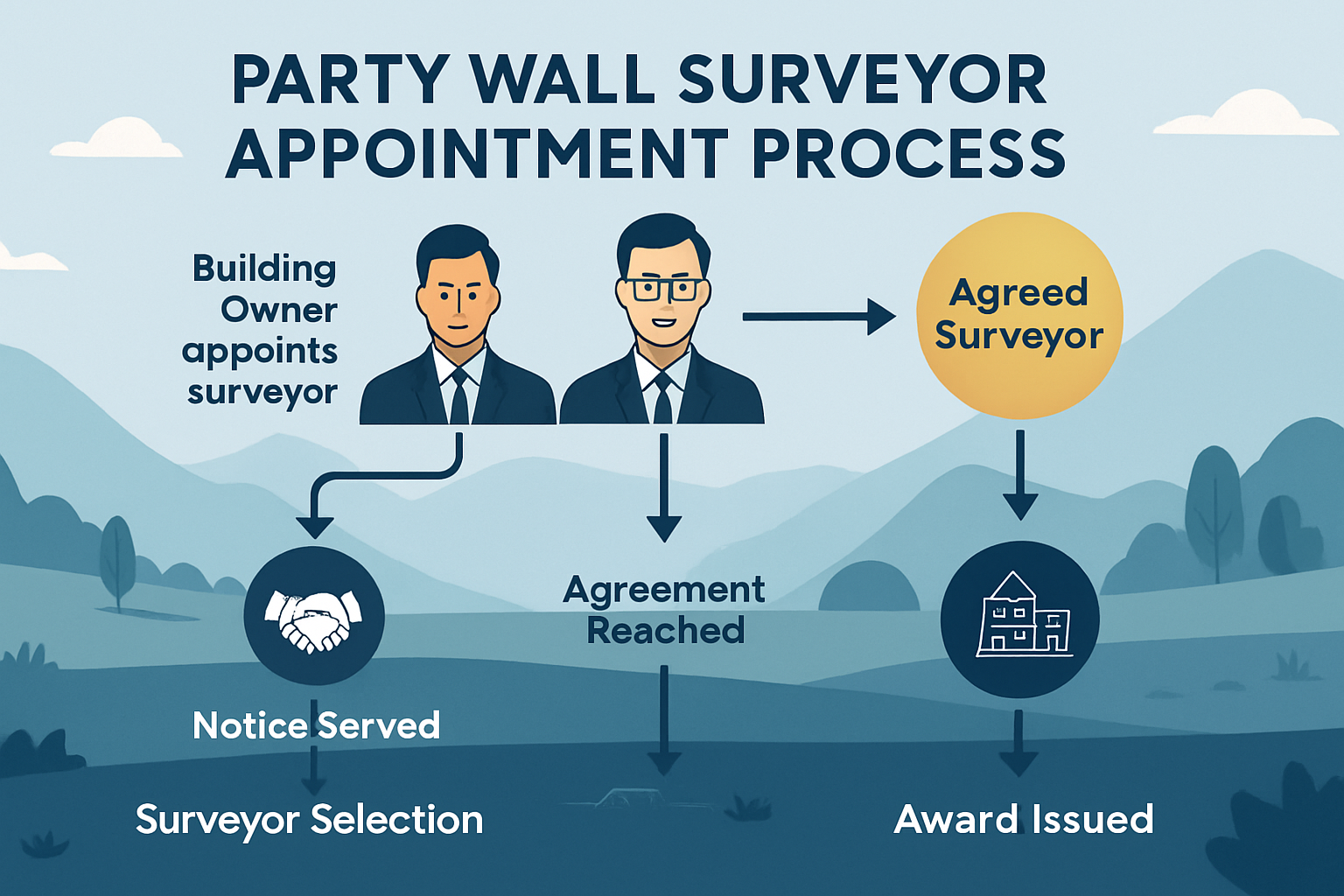
A Party Wall Agreed Surveyor is a qualified professional appointed jointly by both the building owner (the person undertaking construction work) and the adjoining owner (the neighbour whose property shares the party wall or boundary). This single surveyor assumes responsibility for preparing the party wall award, documenting the condition of both properties, and ensuring all work complies with the Party Wall etc. Act 1996.
Unlike the traditional arrangement where each party appoints their own surveyor, the agreed surveyor acts as a neutral third party. This professional must possess the expertise to assess structural implications, understand legal requirements, and maintain absolute impartiality throughout the process.
The Legal Framework
The Party Wall etc. Act 1996 provides the legal foundation for agreed surveyor appointments. Section 10 of the Act explicitly allows for this arrangement, stating that the two owners may agree to appoint the same surveyor. This legislation, which applies across England and Wales, was designed to prevent disputes and provide a clear framework for construction work affecting shared structures.
The agreed surveyor operates under the same legal obligations as individual surveyors, with one critical addition: they must serve both parties with equal diligence and fairness. Any perceived bias can result in the appointment being terminated and the process reverting to separate surveyors.
How a Party Wall Agreed Surveyor Differs from Individual Surveyors
Understanding the distinction between an agreed surveyor and the traditional two-surveyor approach is essential for making an informed decision about your party wall matter.
Traditional Two-Surveyor Approach
In the conventional arrangement:
- The building owner appoints their own surveyor to represent their interests
- The adjoining owner appoints a separate surveyor to protect their property and rights
- These two surveyors must work together to produce a party wall award
- If the surveyors disagree, they must appoint a third surveyor to resolve disputes
- Each party typically pays their own surveyor’s fees, though the building owner often bears all costs
This system provides each party with dedicated representation but can become expensive and time-consuming, particularly if disagreements arise.
The Agreed Surveyor Model
With a Party Wall Agreed Surveyor:
- One professional serves both parties from the outset
- The surveyor must maintain strict neutrality and cannot favour either owner
- Decision-making is streamlined as there’s no need for two surveyors to reach consensus
- The risk of requiring a third surveyor is eliminated
- Costs are shared or allocated as agreed, typically resulting in significant savings
| Aspect | Two Surveyors | Agreed Surveyor |
|---|---|---|
| Number of professionals | 2-3 (including potential third surveyor) | 1 |
| Typical timeline | 8-12 weeks | 4-6 weeks |
| Cost range | £1,500-£4,000+ | £750-£2,000 |
| Dispute resolution | Built-in mechanism via third surveyor | Direct resolution by agreed surveyor |
| Impartiality | Each represents one party | Must remain neutral to both |
For property owners seeking guidance on common misconceptions about party wall agreements, understanding these differences is crucial.
The Role and Responsibilities of a Party Wall Agreed Surveyor
A Party Wall Agreed Surveyor assumes comprehensive responsibilities that encompass the duties normally divided between two separate professionals. Their role is multifaceted and demands both technical expertise and diplomatic skill.
Pre-Construction Duties
Document Review and Validation
The agreed surveyor begins by examining all party wall notices served by the building owner. They verify that notices comply with statutory requirements, contain accurate descriptions of proposed works, and have been served within appropriate timeframes.
Property Condition Surveys
One of the most critical responsibilities involves conducting thorough condition surveys of both the building owner’s and adjoining owner’s properties. These surveys document:
- Existing cracks, settlement, or structural issues
- The current state of the party wall or boundary
- Photographic evidence of pre-construction conditions
- Detailed written descriptions of all relevant areas
This documentation provides essential protection for both parties, establishing a baseline against which any construction-related damage can be assessed.
Award Preparation
The agreed surveyor prepares the party wall award, a legally binding document that:
✅ Describes the proposed works in detail
✅ Sets out the rights and responsibilities of both parties
✅ Establishes working hours and access requirements
✅ Specifies security measures and protective protocols
✅ Determines how costs will be allocated
This award must be fair, comprehensive, and compliant with the Party Wall Act. Both parties receive copies and have 14 days to appeal if they believe the award is unfair.
Construction Oversight
During the building works, the agreed surveyor:
- Monitors compliance with the terms of the award
- Conducts periodic inspections to ensure work proceeds as specified
- Addresses any concerns or complaints from either party
- Documents any variations or changes to the original scope
- Resolves minor disputes before they escalate
Post-Construction Responsibilities
After work completion, the agreed surveyor:
- Performs a final inspection comparing the property’s condition to the pre-construction survey
- Assesses any damage or settlement that may have occurred
- Determines appropriate remedial works if damage is attributable to the construction
- Issues a final certificate confirming completion and compliance
- Resolves any outstanding matters or disputes
Those interested in understanding why property owners hire surveyors will find these comprehensive responsibilities demonstrate the value these professionals provide.
Advantages of Appointing a Party Wall Agreed Surveyor
Choosing to appoint a single agreed surveyor offers numerous benefits that extend beyond simple cost savings.
💰 Significant Cost Reduction
The most immediately apparent advantage is financial. With a Party Wall Agreed Surveyor, you’re paying for one professional instead of two (or potentially three). Typical savings include:
- 50-60% reduction in total surveyor fees compared to dual appointments
- Elimination of the risk of third surveyor fees (which can add £1,000-£2,000)
- Reduced administrative costs associated with coordinating multiple professionals
- Potentially lower overall project costs due to faster resolution
For straightforward party wall matters, the difference might be between paying £1,500-£2,000 for an agreed surveyor versus £3,000-£4,000 for separate surveyors.
⏱️ Faster Resolution and Reduced Delays
Time is often as valuable as money in construction projects. An agreed surveyor typically accelerates the process by:
- Eliminating the need for two surveyors to schedule joint inspections
- Removing delays caused by surveyors disagreeing and requiring third-party arbitration
- Streamlining communication with a single point of contact
- Reducing the back-and-forth typical of dual representation
Projects that might take 10-12 weeks with separate surveyors can often be completed in 6-8 weeks with an agreed surveyor.
🤝 Improved Neighbour Relations
Party wall matters can strain even the best neighbour relationships. An agreed surveyor can help maintain harmony by:
- Demonstrating mutual cooperation and good faith from the outset
- Providing a neutral voice that neither party can accuse of bias
- Facilitating better communication between neighbours
- Reducing the adversarial atmosphere that separate representation can create
- Showing the adjoining owner that the building owner is committed to fairness
Simplified Communication
Managing a construction project involves juggling numerous professionals and stakeholders. A Party Wall Agreed Surveyor simplifies this by:
- Providing one point of contact for all party wall matters
- Eliminating confusion about which surveyor to contact for specific issues
- Ensuring consistent messaging to both parties
- Reducing the risk of miscommunication between multiple surveyors
Enhanced Efficiency
The agreed surveyor model promotes operational efficiency through:
- Single survey visits rather than coordinating separate inspections
- Unified documentation and record-keeping
- Streamlined decision-making without inter-surveyor negotiations
- Reduced administrative burden for all parties
For those planning home extensions and considering cost considerations, the agreed surveyor approach can meaningfully impact the overall project budget.
Potential Drawbacks and Considerations
While the Party Wall Agreed Surveyor approach offers substantial benefits, it’s not universally appropriate for every situation. Understanding the potential limitations helps property owners make informed decisions.
Lack of Dedicated Representation
The most significant concern for some property owners is the absence of a surveyor exclusively advocating for their interests. Considerations include:
- No personal advocate: Unlike having your own surveyor, you don’t have someone whose primary duty is protecting your specific interests
- Shared loyalty: The agreed surveyor must balance both parties’ needs, which may feel less protective than dedicated representation
- Complex disputes: In situations with pre-existing neighbour conflicts, having your own surveyor may provide greater comfort
Risk of Perceived Bias
Even the most professional agreed surveyor may face accusations of favouritism:
- One party may perceive decisions as favouring the other owner
- Without separate representation, there’s no built-in check on the agreed surveyor’s judgement
- If trust breaks down, the entire process may need to restart with separate surveyors
Limited Recourse for Disagreement
When you have your own surveyor:
- You can discuss concerns privately and adjust your position
- Your surveyor can advocate for changes to the award before it’s issued
- There’s a built-in dispute resolution mechanism through the third surveyor
With an agreed surveyor, your options are more limited—you must either accept the award or appeal it formally.
Situations Where Separate Surveyors May Be Preferable
Consider appointing your own surveyor when:
🚩 Pre-existing disputes exist between neighbours
🚩 Complex or extensive works are planned that could significantly impact the adjoining property
🚩 High-value properties where potential damage claims could be substantial
🚩 Previous construction issues have occurred between the parties
🚩 Commercial properties where business interests add complexity
🚩 The adjoining owner is particularly concerned about the proposed works
Withdrawal Rights
Importantly, either party can withdraw consent for the agreed surveyor arrangement at any time and appoint their own surveyor. This provides a safety valve but can result in:
- Wasted fees paid to the agreed surveyor
- Significant delays while new surveyors are appointed and brought up to speed
- Increased overall costs
- Damaged neighbour relations
The Appointment Process for a Party Wall Agreed Surveyor
Appointing a Party Wall Agreed Surveyor follows a specific sequence of steps, each with important legal and practical implications.
Step 1: Serve the Party Wall Notice
The building owner must first serve appropriate notice under the Party Wall Act. This notice:
- Must be served at least two months before work begins for most party wall works
- Should describe the proposed works in detail
- Must be in writing and properly formatted
- Should be served on all adjoining owners whose properties may be affected
The notice will typically ask the adjoining owner to consent to the works and indicate whether they agree to appoint an agreed surveyor.
Step 2: Discuss the Agreed Surveyor Option
Once notice is served, the building owner should:
- Explain the agreed surveyor concept to the adjoining owner
- Highlight the cost and time benefits for both parties
- Address any concerns or questions the neighbour may have
- Emphasize the surveyor’s duty of impartiality
This conversation is crucial. Many adjoining owners are unfamiliar with party wall procedures and may initially be suspicious or defensive. Clear, respectful communication can make the difference between cooperation and conflict.
Step 3: Select a Qualified Professional
Both parties must agree on which surveyor to appoint. Key selection criteria include:
Qualifications and Memberships
- Member of the Royal Institution of Chartered Surveyors (RICS)
- Specialist knowledge of the Party Wall Act 1996
- Relevant professional indemnity insurance
- Experience with similar types of construction work
Experience and Reputation
- Track record of party wall matters in your area
- Positive references from previous clients
- Understanding of local building practices and regulations
- Reputation for impartiality and professionalism
Practical Considerations
- Geographic proximity to the properties
- Availability to commence work promptly
- Reasonable fee structure
- Clear communication style
Exploring options through professional surveyor directories can help identify qualified candidates.
Step 4: Formalize the Appointment
Once both parties agree on a surveyor, the appointment must be formalized in writing. This typically involves:
- Written confirmation from both the building owner and adjoining owner
- Agreement on fee structure and payment responsibilities
- Confirmation of the surveyor’s acceptance of the appointment
- Documentation of the scope of works to be covered
The agreed surveyor will then send formal appointment letters to both parties, outlining their role, responsibilities, and the process going forward.
Step 5: Cooperate Throughout the Process
After appointment, both parties should:
✓ Respond promptly to surveyor requests for information or access
✓ Attend scheduled inspections or ensure property access
✓ Review documents carefully when provided
✓ Raise concerns early rather than waiting until the award is issued
✓ Maintain open communication with the surveyor and each other
For those navigating party wall disputes, early cooperation with an agreed surveyor can prevent many common problems.
Costs and Fee Structures for Party Wall Agreed Surveyors
Understanding the financial implications of appointing a Party Wall Agreed Surveyor helps with budgeting and ensures transparency throughout the process.
Typical Fee Ranges
Party wall surveyor fees vary based on several factors, but typical ranges for agreed surveyors include:
Simple party wall matters (minor works, straightforward properties):
- £750 – £1,200 total
Standard residential projects (loft conversions, single-story extensions):
- £1,200 – £2,000 total
Complex or extensive works (basements, multi-story extensions, multiple party walls):
- £2,000 – £3,500+ total
Commercial properties or particularly complex situations:
- £3,500 – £6,000+ total
These fees typically cover all aspects of the agreed surveyor’s work, including initial surveys, award preparation, construction monitoring, and final inspections.
Factors Affecting Costs
Several variables influence the final fee:
Project Complexity
- Number of party walls or boundaries affected
- Technical complexity of the proposed works
- Extent of excavation or structural alterations
- Number of properties involved
Property Characteristics
- Property value and size
- Age and condition of existing structures
- Accessibility for inspections
- Distance between properties requiring survey
Surveyor’s Experience and Location
- London and Southeast England typically command higher fees
- More experienced specialists may charge premium rates
- RICS-qualified surveyors generally charge more than non-qualified practitioners
Process Duration
- Extended construction timelines requiring multiple inspections
- Delays caused by either party
- Complexity of post-construction remedial work assessments
Fee Payment Arrangements
The Party Wall Act specifies that the building owner is generally responsible for all reasonable costs associated with the party wall process. However, with an agreed surveyor, payment arrangements can be structured in various ways:
Option 1: Building Owner Pays All
The most common arrangement, where the building owner covers the entire agreed surveyor fee. This approach:
- Reflects the principle that the building owner initiates the works
- Simplifies payment logistics
- May encourage adjoining owner cooperation
Option 2: Shared Costs
Some parties agree to split the agreed surveyor’s fees equally or proportionally. This can:
- Further reduce individual costs
- Demonstrate good faith on both sides
- Create shared investment in the process
Option 3: Specified in the Award
The agreed surveyor may determine the appropriate cost allocation in the party wall award based on the specific circumstances.
Comparing Costs: Agreed vs. Separate Surveyors
Consider a typical loft conversion project:
Agreed Surveyor Approach:
- Agreed surveyor fee: £1,500
- Total cost: £1,500
Separate Surveyor Approach:
- Building owner’s surveyor: £1,200
- Adjoining owner’s surveyor: £1,200
- Risk of third surveyor (if needed): £1,500
- Potential total cost: £2,400 – £3,900
The savings become even more pronounced for simpler projects or when multiple properties are involved.
Additional Costs to Consider
Beyond the surveyor’s fees, budget for:
- Remedial works: If construction causes damage, repair costs can be substantial
- Specialist reports: Structural engineer assessments if required
- Legal advice: If disputes arise requiring solicitor involvement
- Appeal costs: If either party challenges the award
Those researching structural engineering needs should understand how these professionals may complement the party wall process.
Qualities to Look for in a Party Wall Agreed Surveyor
Selecting the right professional is crucial to a successful party wall process. Key qualities distinguish exceptional agreed surveyors from merely adequate ones.
Professional Qualifications
RICS Membership
Look for surveyors who are members of the Royal Institution of Chartered Surveyors (RICS). This membership indicates:
- Formal education and training in surveying
- Adherence to professional standards and ethics
- Continuing professional development
- Professional indemnity insurance
- Accountability to a regulatory body
Party Wall Specialist Knowledge
The Party Wall Act is a specialized area. Seek surveyors who:
- Regularly handle party wall matters (not occasional practitioners)
- Demonstrate detailed knowledge of the Act and case law
- Understand local building practices and regulations
- Have experience with your specific type of project
Essential Personal Qualities
Impartiality and Fairness
An agreed surveyor must be scrupulously neutral. Look for evidence of:
- Balanced decision-making in previous cases
- Ability to explain both sides of issues clearly
- Reputation for fairness among both building and adjoining owners
- No prior relationship with either party that could suggest bias
Communication Skills
Effective communication prevents misunderstandings and disputes. Your agreed surveyor should:
- Explain technical matters in accessible language
- Respond promptly to queries and concerns
- Provide clear, well-organized documentation
- Listen actively to both parties’ perspectives
- Manage expectations realistically
Diplomatic Ability
Party wall matters can be emotionally charged. The best agreed surveyors:
- Navigate sensitive neighbour relationships tactfully
- De-escalate tensions before they become disputes
- Find practical solutions to seemingly intractable problems
- Maintain professionalism even when parties become difficult
Attention to Detail
Small oversights can create significant problems. Look for surveyors who:
- Conduct thorough, comprehensive property surveys
- Produce detailed, accurate documentation
- Notice subtle signs of structural issues
- Ensure awards cover all necessary provisions
Practical Experience
Relevant Project Experience
Ideally, your agreed surveyor should have handled projects similar to yours:
- Same type of construction work (loft conversion, basement, extension)
- Similar property types (terraced houses, semi-detached, flats)
- Comparable complexity levels
- Local area knowledge
Problem-Solving Track Record
Ask potential surveyors about:
- Challenging cases they’ve resolved
- How they’ve handled disagreements between parties
- Their approach to unexpected complications
- Success rates in avoiding third surveyor appointments
Availability and Responsiveness
Time-sensitive projects require surveyors who:
- Can commence work within your timeline
- Respond to communications within 24-48 hours
- Conduct inspections promptly
- Produce awards without unnecessary delays
Transparent Fee Structure
Reputable agreed surveyors provide:
- Clear, written fee quotations
- Explanation of what services are included
- Transparent billing practices
- No hidden charges or unexpected costs
For additional insights on what homeowners should know about their property, consider how party wall matters fit into broader property ownership responsibilities.
Common Scenarios Where a Party Wall Agreed Surveyor Is Beneficial
Understanding specific situations where the agreed surveyor approach works particularly well helps property owners make informed decisions.
Loft Conversions
Loft conversions frequently trigger party wall requirements, especially in terraced or semi-detached properties. An agreed surveyor is often ideal because:
- The works typically affect party walls in predictable, straightforward ways
- Structural implications are generally well-understood
- Neighbours in similar properties may plan similar conversions themselves
- Costs are moderate, making savings particularly valuable
- The cooperative approach can inspire neighbours to undertake their own conversions
Typical party wall issues in loft conversions:
- Steel beam insertions into party walls
- Raising party wall height for headroom
- Cutting into party wall for staircase access
- Potential vibration from construction work
Single-Story Rear Extensions
These popular home improvements commonly involve party walls, particularly in terraced properties. The agreed surveyor model works well because:
- Extensions typically follow standard designs
- Impact on adjoining properties is usually minimal
- Neighbours often have similar extensions already
- The friendly, cooperative approach suits residential areas
- Cost savings are significant relative to project budgets
Basement Excavations and Conversions
While more complex, basement projects can still benefit from agreed surveyors when:
- Both parties understand the scope and complexity
- The adjoining owner has confidence in the proposed methodology
- The building owner is using reputable contractors
- Good neighbour relations exist pre-construction
- Both parties want to minimize costs
However, given the higher risks associated with excavation, some adjoining owners prefer separate representation for basement projects. For those considering such work, understanding basement party wall requirements is essential.
Minor Repairs and Maintenance
For straightforward party wall repairs, an agreed surveyor is almost always the sensible choice:
- Works are typically non-controversial
- Costs should be minimal
- Quick resolution benefits both parties
- The cooperative approach maintains good relations
Examples include:
- Repointing party walls
- Replacing damaged coping stones
- Minor weatherproofing repairs
- Chimney stack maintenance
New Build Developments
When constructing new properties adjacent to existing buildings, agreed surveyors can be beneficial if:
- The developer has a good reputation
- Detailed plans clearly show the impact on existing properties
- The adjoining owner is reassured by the developer’s approach
- Professional project management is in place
However, many adjoining owners facing new developments prefer their own representation given the scale and potential impact.
Situations Requiring Separate Surveyors
Conversely, separate representation is often advisable when:
❌ Significant pre-existing disputes exist between neighbours
❌ Complex structural issues are present in either property
❌ High-value properties where potential damage claims are substantial
❌ Commercial interests are at stake
❌ The adjoining owner lacks confidence in the building owner or their contractors
❌ Previous construction problems have occurred
❌ Extensive or unusual works are proposed
Frequently Asked Questions About Party Wall Agreed Surveyors
Can I change my mind after appointing an agreed surveyor?
Yes. Either party can withdraw consent for the agreed surveyor arrangement at any time and appoint their own surveyor. However, this typically means:
- Losing any fees already paid to the agreed surveyor
- Starting the process again with new surveyors
- Incurring additional costs and delays
- Potentially damaging neighbour relations
What happens if I disagree with the agreed surveyor’s award?
If you believe the award is unfair, you have 14 days from receipt to appeal to the County Court. The court will review the award and can:
- Uphold it as fair and reasonable
- Modify specific provisions
- Order a new award to be prepared
- Award costs to either party
Appeals should be based on substantive issues with the award, not mere dissatisfaction with specific terms.
Does the agreed surveyor favour the building owner?
A professional agreed surveyor should show absolutely no favouritism. They are bound by:
- Professional ethics and RICS standards
- Legal duties under the Party Wall Act
- Reputational considerations
- Potential liability for biased decisions
If you believe your agreed surveyor is biased, you can withdraw consent and appoint your own surveyor.
How long does the party wall process take with an agreed surveyor?
Typical timelines include:
- Initial survey and assessment: 1-2 weeks
- Award preparation: 2-3 weeks
- Review and finalization: 1-2 weeks
- Total from appointment to award: 4-7 weeks
This compares favourably to 8-12 weeks often required with separate surveyors, particularly if disagreements arise.
Can the agreed surveyor also be my building surveyor or architect?
Generally, no. The agreed surveyor should be independent and not have a pre-existing professional relationship with either party that could compromise their impartiality. Using your existing building surveyor or architect as the agreed surveyor would create a clear conflict of interest.
What if my neighbour refuses to engage with the party wall process?
If your neighbour doesn’t respond to the party wall notice within 14 days, they are deemed to have dissented. You must then:
- Appoint your own surveyor
- Arrange for a surveyor to be appointed on behalf of the adjoining owner (if they still don’t appoint one)
- Proceed with the two-surveyor process
The agreed surveyor option requires active cooperation from both parties. For guidance on what to do when a neighbour refuses party wall works, specialized advice may be necessary.
Legal Rights and Protections Under the Party Wall Act
Understanding your legal position helps you navigate the party wall process confidently, whether using an agreed surveyor or separate representation.
Building Owner Rights
Under the Party Wall Act 1996, building owners have the right to:
✅ Undertake specified works after proper notice, even if the adjoining owner objects
✅ Access the adjoining property for necessary inspections and work (with reasonable notice)
✅ Require the adjoining owner to participate in the party wall process
✅ Proceed with works once a valid award is in place
However, these rights come with corresponding obligations:
📋 Serve proper notice in the required format and timeframe
📋 Cover reasonable costs associated with the party wall process
📋 Compensate for damage caused by the works
📋 Comply with the award and all its provisions
📋 Minimize disruption to adjoining owners
Adjoining Owner Rights
Adjoining owners are protected by several important rights:
✅ Receive proper notice of proposed works
✅ Appoint a surveyor (or agree to an agreed surveyor) to protect their interests
✅ Have their property surveyed before works commence
✅ Receive compensation for any damage caused
✅ Challenge unreasonable awards through the appeals process
✅ Require works to be carried out in accordance with the award
Adjoining owners cannot:
❌ Unreasonably prevent works from proceeding
❌ Demand payment for agreeing to works
❌ Insist on improvements to their property at the building owner’s expense
The Agreed Surveyor’s Legal Position
The agreed surveyor operates under specific legal constraints:
Duty of Impartiality: Must serve both parties equally and fairly
Professional Standards: Must comply with RICS guidelines and professional ethics
Statutory Obligations: Must follow Party Wall Act requirements precisely
Liability: Can be held accountable for negligent or biased decisions
Enforcement and Remedies
If either party fails to comply with the award:
- The other party can seek an injunction to prevent or compel specific actions
- Damages may be claimed for losses resulting from non-compliance
- In extreme cases, criminal prosecution is possible for deliberate interference with party wall rights
For those concerned about the consequences of ignoring the Party Wall Act, understanding these enforcement mechanisms is crucial.
Best Practices for Working with a Party Wall Agreed Surveyor
Maximizing the benefits of the agreed surveyor approach requires cooperation, communication, and realistic expectations from both parties.
For Building Owners
Before Appointing the Surveyor
- Discuss your plans with your neighbour early – informal conversation before formal notice can prevent misunderstandings
- Provide detailed information about your proposed works, including plans and specifications
- Explain the agreed surveyor concept clearly and emphasize the mutual benefits
- Be prepared to answer questions and address concerns patiently
- Suggest qualified surveyors but allow your neighbour input into the selection
During the Process
- Respond promptly to surveyor requests for information or documentation
- Ensure your contractors understand the party wall requirements and award provisions
- Maintain open communication with both the surveyor and your neighbour
- Address concerns immediately rather than allowing them to escalate
- Keep the surveyor informed of any changes to your plans or timeline
After the Award
- Comply fully with all award provisions
- Provide advance notice before commencing works
- Allow surveyor inspections as specified in the award
- Document the works with photographs and records
- Address any damage promptly and fairly
For Adjoining Owners
When Receiving Notice
- Read the notice carefully and seek clarification on anything unclear
- Consider the agreed surveyor option objectively, focusing on the benefits
- Ask questions about the surveyor’s qualifications and experience
- Ensure you’re comfortable with the proposed professional before agreeing
- Understand your rights to appoint your own surveyor if you prefer
Throughout the Process
- Provide access for surveys and inspections as reasonably requested
- Point out any concerns about your property’s condition during the initial survey
- Review the draft award carefully and raise any issues before it’s finalized
- Maintain perspective – remember that your neighbour has legal rights to undertake reasonable works
- Communicate concerns to the surveyor rather than directly confronting your neighbour
During Construction
- Monitor the works without interfering unreasonably
- Report any concerns to the agreed surveyor immediately
- Document any issues with photographs and written notes
- Allow reasonable working hours as specified in the award
- Cooperate with inspections required by the surveyor
For Both Parties
Communication Guidelines
- Be respectful and courteous in all interactions
- Put agreements in writing to avoid misunderstandings
- Respond to communications within reasonable timeframes
- Focus on facts rather than emotions
- Seek clarification rather than making assumptions
Realistic Expectations
- Understand that some disruption is inevitable during construction
- Recognize that perfect outcomes are rare – the goal is fairness, not perfection
- Accept that compromise may be necessary from both sides
- Remember that the surveyor cannot please everyone all the time
- Appreciate that the process protects both parties even if it seems bureaucratic
Conclusion: Making the Right Choice for Your Party Wall Matters
The decision to appoint a Party Wall Agreed Surveyor represents more than just a cost-saving measure—it’s a statement of intent to handle your construction project cooperatively, professionally, and with respect for your neighbour’s legitimate interests. For many residential projects, particularly straightforward extensions, loft conversions, and minor works, the agreed surveyor approach offers compelling advantages in terms of cost, efficiency, and neighbour relations.
However, this approach isn’t universally appropriate. Complex projects, pre-existing disputes, or situations where either party feels uncomfortable with shared representation may warrant separate surveyors. The key is making an informed decision based on your specific circumstances, the nature of your proposed works, and your relationship with your neighbour.
Next Steps
If you’re considering the Party Wall Agreed Surveyor route:
- Discuss the concept with your neighbour early in your planning process
- Research qualified surveyors in your area with relevant experience
- Obtain quotations from several professionals to compare fees and approaches
- Check references and professional credentials carefully
- Ensure both parties are comfortable with the selected surveyor before proceeding
- Formalize the appointment with clear written agreements
- Cooperate fully throughout the process to maximize the benefits
For professional guidance on party wall matters and to find qualified surveyors who can serve as agreed surveyors, explore the resources available through Prince Surveyors. Their comprehensive blog offers additional insights into party wall procedures, building surveys, and property matters.
Whether you’re planning a major renovation or a minor alteration, understanding your options regarding party wall surveyors empowers you to make decisions that protect your interests, respect your neighbour’s rights, and keep your project on track. The Party Wall Agreed Surveyor model, when appropriate, offers a pragmatic, cost-effective path forward that benefits everyone involved. 🏡
References
[1] Party Wall etc. Act 1996, UK Parliament, https://www.legislation.gov.uk/ukpga/1996/40/contents
[2] Royal Institution of Chartered Surveyors (RICS), “Party Wall Legislation and Procedure,” Professional Guidance, 2023
[3] Ministry of Housing, Communities & Local Government, “The Party Wall etc. Act 1996: Explanatory Booklet,” 2022
[4] Pyramus & Thisbe Club, “Party Wall Awards: Best Practice Guidelines,” 2024